Les Réseaux de la Clandestinité
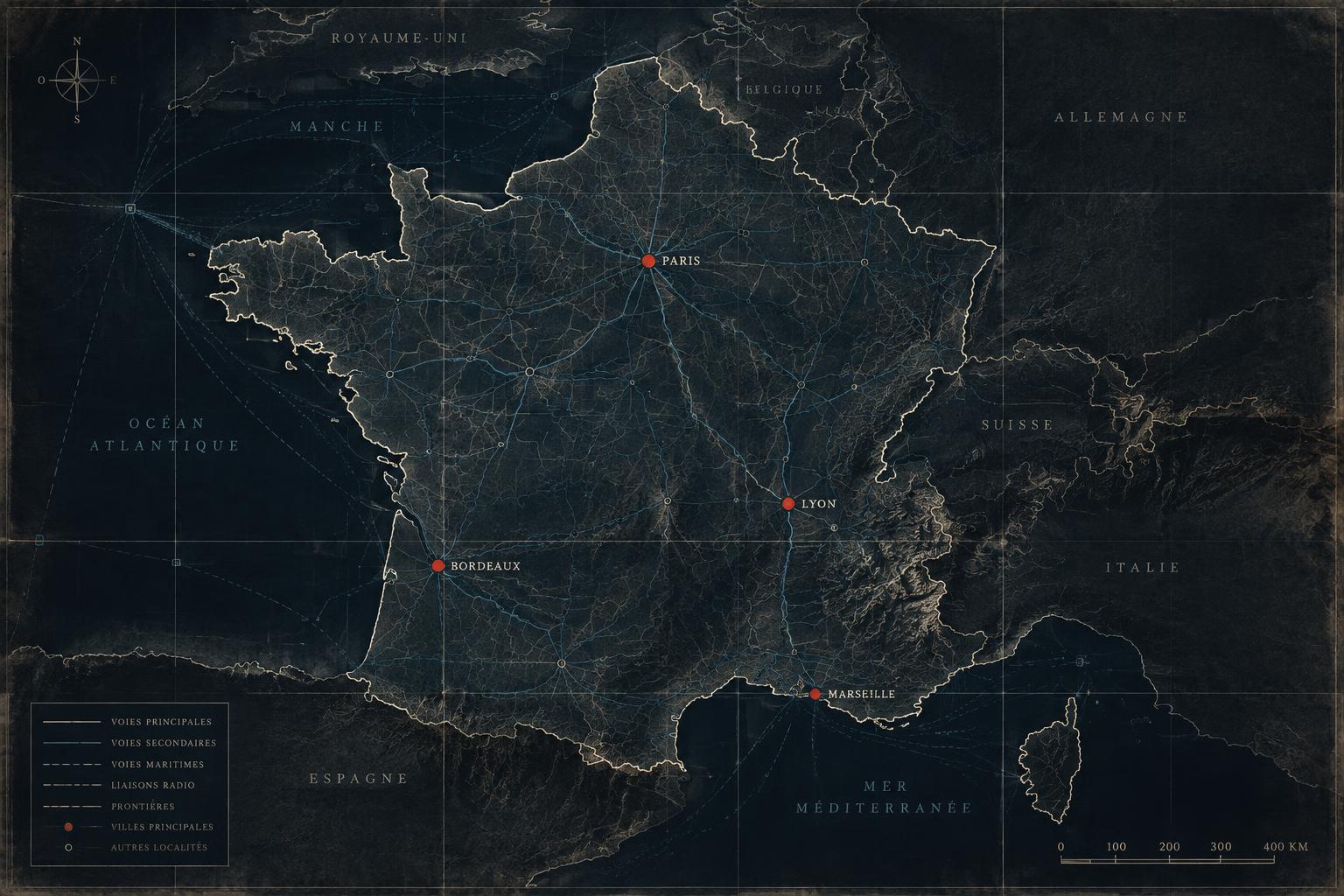
Map of metropolitan France under German military occupation
Historical Documentation • Clandestine Communications

Communications of the French Resistance

When transmitting a single radio signal could lead to execution within minutes, underground networks developed three distinct operational methods: physical steganography hidden in daily bread, one-way public broadcasts over the BBC, and unwritten living codes spoken in the streets of Paris.

Three Operational Fronts
  • 1.
    The Baker of Lyon: Tactile crust Braille and window display semaphores (Jean-Claude Beaumont).
  • 2.
    The SOE Pianist: Open-channel BBC broadcasts, codebooks on silk, and D-Day poetry (Georges Bégué).
  • 3.
    The Women of Paris: Unwritten living codes, casual street conversations, and railway sabotage (Agnès).
PART 01Physical Object Steganography & Self-Sacrifice
Rue Del, Lyon (3 blocks from Gestapo HQ) October 1942 – August 1943

The Baker's Cipher: The Ghost of Rue Del

Tactile Steganography & Visual Semaphores in Plain Sight of the Gestapo

How an ordinary craftsman with no military background turned morning bread displays into optical telegraphs and crust air bubbles into tactile Braille payloads, saving 1,200 people from Operation Thunderclap before sacrificing his life to shatter Gestapo surveillance.

Core Explanatory Principle:Absolute Invisibility through Routine: The enemy cannot intercept communications when the transmission medium is an essential daily commodity carried past checkpoints by innocent hands.
The Baker of Lyon
PRIMARY ARCHIVAL RECORD

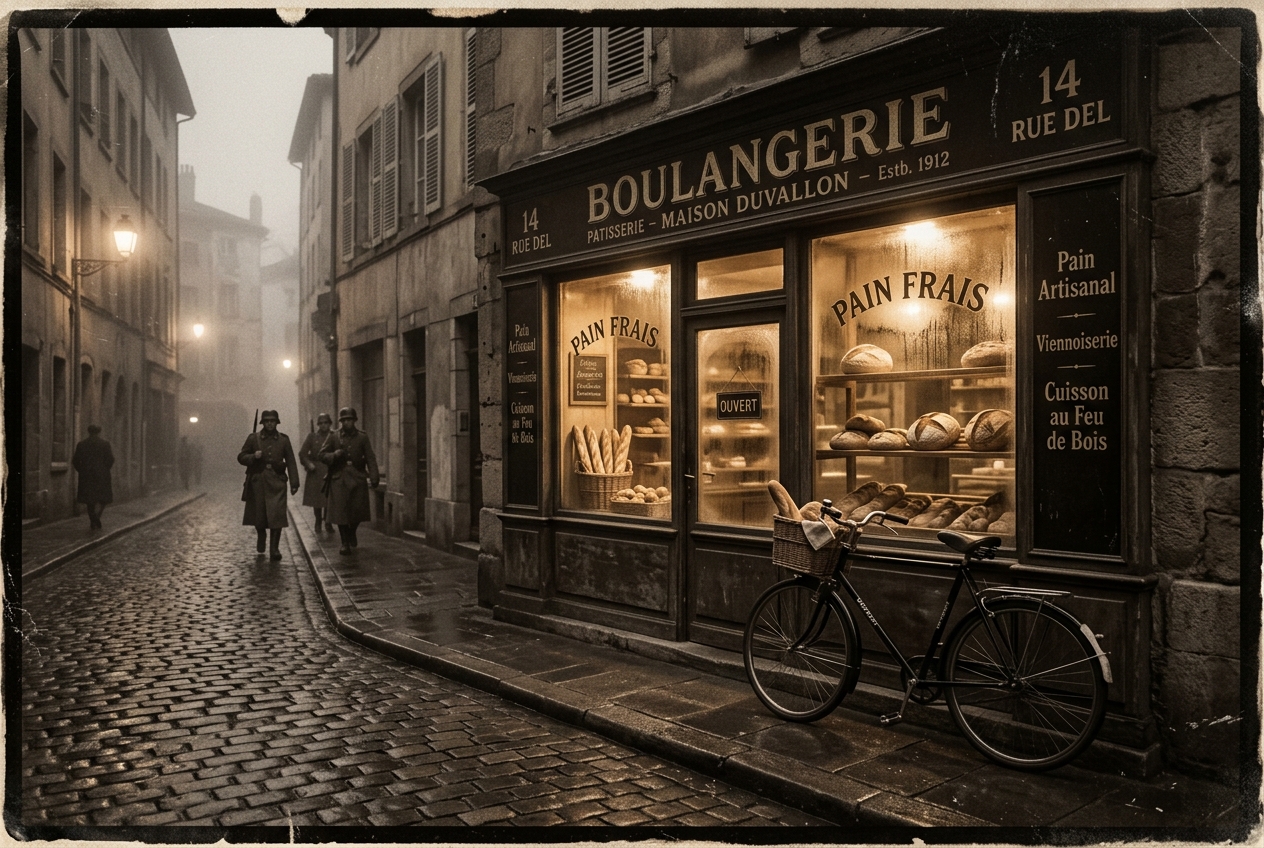
Boulangerie Beaumont, 14 Rue Del, Lyon (March 1943). Morning mist as a German patrol passes the bread semaphore window.

Provenance: CHRD Lyon • Fonds Zimmerman (1943/IV-B/882)
Operational Mechanism — Interactive Field Record
Rue Del Storefront • Clandestine Bread Semaphore

The Bakery Window Semaphore

BOULANGERIE BEAUMONT
PATROL TIME: 07:15 AM
Traditional Baguette — Horizontal Position
Résistance Decoded IntelligenceCLEARANCE: MAQUIS LEVEL A

IMMINENT GESTAPO RAID: Scheduled sweep planned for this evening in the district. Evacuate active safehouses.

Historical Record: Used over 40 times between Nov 1942 and July 1943. Prevented dozens of Gestapo night roundups.

Tactile Steganography • Modified Braille Punctures

The Crust Puncture Decoder

A
U
G
U
S
T
2
0
WOODEN SKEWER PUNCTURE DEPTH: 1.5MMLOOKS LIKE NATURAL YEAST BLISTERS

Why German Sentries Never Caught It: Bread rises in heat; steam bubbles naturally break through the crust during baking. When Zimmerman ran his fingertips across the bread, Jean-Claude calmly explained: "Bread is a living thing; no two loaves have identical bubbles." Plausible deniability saved his life until August 1943.

Operation Thunderclap (Aktion Donnerschlag) • August 1943

The 144-Hour Evacuation Tracker

1,200 LIVES AT STAKE
August 15–18, 1943Day & Night
Phase 4 of 7

The 5-Day Miracle Evacuation

1,200 people (Allied SOE agents, resistance commanders, couriers, Jewish families in attics) are spirited out of Lyon through traboules, safehouses, and southern trains.

Gestapo Inquisitor Zimmerman's Calculation

Zimmerman delayed arresting Beaumont for 72 hours, using him as live bait to trace all 1,200 evacuees. He positioned telephoto surveillance on all surrounding roofs, waiting to strike simultaneously on August 19.

Beaumont's Decisive Counter-Checkmate

Realizing he was bait, Jean-Claude surrendered himself on August 18 with a forged sole-guilt confession. This shattered Zimmerman's pretext for ongoing covert surveillance, legally forcing the Gestapo to detain only him and leaving the 1,200 evacuees safe.

Census of the 1,200 Rescued Citizens
420
Resistance Cell Leaders & Couriers
380
Jewish Families Hidden in Attics
210
Sympathetic Clergy & Rail Workers
190
Allied SOE & Escaped Airmen
Chronological Chapters (6)Full Historical Text
CHAPTER 01
JUNE 1940 – OCTOBER 1942
Historical Note:

Ordinary decency in the face of systemic tyranny: Beaumont rejected collaboration before he had any contact with the underground movement.

The Shattered City & The Moral Crossroads

From generational culinary artisan to occupied subject

"Food became a weapon of control. Jean-Claude could have chosen the easy path, and nobody would have blamed him. But he had watched the Gestapo drag his neighbor into the night."Historical Dossier, Lyon Resistance

Before the Nazi jackboots echoed through the cobblestone streets of Lyon, the city was celebrated as the gastronomic heart of France—a sanctuary where food was art, heritage, and identity. Jean-Claude Beaumont was an ordinary craftsman in this world. At 28 years old, he inherited his father's bakery on Rue Del, a modest neighborhood shop that had served local families for three generations.

His day began at 3:00 in the morning, stoking the brick oven his grandfather had built with his own hands, mixing dough according to timeless family formulas. The neighborhood knew him as a quiet baker with a warm smile whose croissants were lighter than air. He had no military training, no intelligence connections, and no reason to believe he would ever become anything more than a neighborhood baker.

Then came June 1940. The German Wehrmacht rolled into Lyon. Curfews were enforced, radios were confiscated, and anyone caught tuning to the BBC faced execution. The Gestapo requisitioned a hotel less than three blocks from Jean-Claude's bakery, transforming it into a house of screams. Food became a primary weapon of control: ration cards dictated life or death, and collaboration was rewarded with extra butter, white flour, and safety.

Collaborating bakers thrived, but Jean-Claude had watched the Gestapo drag his neighbor, a schoolteacher named Monsieur Arnaud, from his bed at midnight for possessing a forbidden book. He had seen the terror in the eyes of Jewish neighbors as regulations tightened, and he had heard the whispers of deportation trains departing Lyon that never returned. When German officers offered him protection and unlimited flour in exchange for allegiance, he quietly declined.

CHAPTER 02
OCTOBER 1942
Historical Note:

The power of invisibility: A baker baking bread at 3:00 AM every morning draws zero suspicion from surveillance units.

The Note Under the Coin Dish

The recruitment that offered only a death sentence

In October 1942, the French Resistance made contact. A woman Jean-Claude had never seen before entered just before closing time and ordered an unprecedented combination: exactly three baguettes and two small round loaves arranged on the counter in a specific geometric pattern. She paid with exact change and departed in silence.

Tucked beneath the copper coin dish lay a tiny slip of paper written in cramped handwriting. The Resistance needed someone whose routine was so fixed, so mundane, and so ordinary that it became invisible. They needed someone the Germans saw every morning without suspicion. They needed a baker.

What the note did not say, but what Jean-Claude understood with absolute clarity, was that accepting meant signing his own death warrant. In Gestapo basements, traitors were not given quick trials; they were broken for sport. Jean-Claude sat alone in his empty bakery that night, smelling the yeast and the warmth of his grandfather's ovens, and made his decision.

The next morning at dawn, he placed a single loaf of bread in his front window, angled precisely at 45 degrees. The war had officially arrived on Rue Del.

CHAPTER 03
WINTER 1942 – SPRING 1943
Historical Note:

Plausible Deniability & Steganography: Even if an inspecting officer touched the crust, proving that fermentation bubbles were coded numbers was impossible.

The Dual-Layer Bread Cipher System

Window semaphores and micro-Braille crust steganography

Together with resistance engineers, Jean-Claude established a revolutionary two-tiered communication pipeline that operated in broad daylight.

Layer 1: The Window Display Semaphore. Every morning at 7:15 AM, German patrols marched past Rue Del. In the window, the arrangement of fresh bread acted as an optical telegraph: a horizontal baguette warned of a Gestapo night raid; two stacked round loaves indicated a new checkpoint on designated bridges; three croissants signaled a safe route for clandestine supply convoys.

Layer 2: Micro-Braille Crust Steganography. While visual displays provided high-level alerts, operational specifics—coordinates, departure hours, safehouse numbers—required data payloads. Before wrapping finished loaves in brown paper, Jean-Claude used a thin wooden skewer to pierce micro-holes into the hot crust.

To any inspecting German sentry, the punctures looked like natural air blisters formed during fermentation and baking. In reality, they spelled out numbers using a modified Braille code. Unwitting neighborhood customers carried the bread past Wehrmacht sentries without suspicion. At the safehouse, resistance operatives broke open the bread and read the tactical intelligence.

Technical Architecture:
Layer 1 (Optical): Understood in 2 seconds from the sidewalk; changed as stock sold naturally.
Layer 2 (Tactile Payload): 6-dot modified Braille numeral system; punctures pierced at 1.5mm depth into hot crust.
Plausible Deniability: If interrogated, Beaumont sold bread to random public buyers; customers had no knowledge of being couriers.
CHAPTER 04
MARCH 1943
Historical Note:

Mastery of psychological cover: By volunteering his baking process, Beaumont neutralized Zimmerman's suspicions.

The Berlin Inquisitor: Klaus Zimmerman

The confrontation between counter-intelligence and the baker

By early 1943, the Gestapo realized an undetectable intelligence leak was bleeding their operations dry. Raids found warm, empty safehouses; ambushes met devastating counter-ambushes. Berlin dispatched Klaus Zimmerman, an obsessive counter-intelligence inquisitor who searched for patterns where others saw chaos.

On a freezing dawn in March, Zimmerman entered the bakery alone 30 minutes before opening. His jackboots clicked with deliberate menace on the tile. He scrutinized Jean-Claude's hands, asked pointed questions about regular customers, pre-war politics, and overheard German officers.

Zimmerman then walked to the bread racks, picked up a baguette, and ran his fingertips across the crust under the lamplight as if reading Braille. Ice flooded Jean-Claude's veins—the German was literally touching the secret code. Zimmerman demanded to know why some loaves had tiny holes and irregularities.

Jean-Claude remained completely composed. With the quiet patience of a generational craftsman, he explained that dough is a living entity, that air pockets form naturally during yeast fermentation, and invited Zimmerman into the back to observe the entire dough-making process. Guilty men conceal; innocent craftsmen share their craft proudly. Zimmerman declined, but continued his inspection.

Twenty agonizing minutes later, a young soldier burst through the door shouting that a resistance firefight had broken out three blocks away in the railroad district. Zimmerman rushed out. Jean-Claude's hands shook uncontrollably once the door swung shut. When the Resistance offered him immediate extraction to the countryside, he refused: 'If I vanish, Zimmerman will tear apart the neighborhood. The ghost must haunt the same street.'

CHAPTER 05
JUNE 1943
Historical Note:

Improvised meta-signaling: Beaumont used visual dissonance to communicate that the intelligence pipeline itself was compromised.

The Poisoned Bait & The 20-Minute Gamble

Surviving the canary trap with an emergency display

In June 1943, Zimmerman deployed a counter-espionage canary trap: planting distinct fabricated raid plans with different German commands to see which false operational briefing leaked to the resistance.

Private Ernst Weber, an anti-Nazi Austrian conscript who frequented the bakery and bonded with Jean-Claude over memories of home, recognized the trap. As he paid for his morning baguette, Weber whispered: 'My commander briefed a Thursday raid on the textile district. But he smiled like a man setting a trap. Do not trust it.'

Jean-Claude faced an impossible dilemma: if he encoded the raid, Zimmerman would trace the briefing and execute the entire network. If he stayed silent, the resistance might walk into future legitimate raids. The bread code had no symbol for 'our network is compromised.'

Jean-Claude took an unprecedented gamble: at 6:40 AM, he placed EVERY SINGLE LOAF in his front window completely upside down. In French bakery tradition, inverted bread is an absurdity and bad luck. To resistance scouts, it was a screaming flare of catastrophic danger.

He left the inverted display in place for exactly 20 minutes—long enough for couriers to photograph and recognize—then reset it before German customers arrived for breakfast. The Resistance understood instantly and went completely dark. Safehouses were evacuated, contacts suspended. When Zimmerman raided the textile district, his men kicked in doors to find empty warehouses and zero ambushes. The trap caught only shadows.

CHAPTER 06
AUGUST 14–23, 1943
Historical Note:

The master checkmate: Beaumont willingly surrendered his own life to detonate the Gestapo's surveillance trap before the evacuation could be intercepted.

Operation Thunderclap & The Ultimate Sacrifice

1,200 souls saved, the sole-guilt confession, and the firing squad

On August 14, 1943, SS Hauptsturmführer Dietrich Kau entered the bakery and casually discussed Operation Thunderclap with his subordinates: a massive, coordinated dawn purge scheduled for August 20 targeting 1,200 resistance members, families, children, and hidden Jewish citizens.

Fewer than 50 people in France knew the date. Standard numeral Braille was too slow for an existential catastrophe. Jean-Claude took a fatal risk: he used his skewer to pierce 'AUGUST 20' in large Latin letters directly across special round boules.

When courier Simone entered that evening, Jean-Claude handed her the loaves and spoke loudly for other customers: 'These special loaves are for large families for the Feast of the Assumption—consume them before they spoil!' Simone noticed the upward letters and gasped. But Zimmerman had placed an undercover German female agent as Jean-Claude's new bakery assistant. She witnessed the exchange and alerted Gestapo headquarters within 20 minutes.

Zimmerman did not arrest Jean-Claude immediately. Instead, he turned him into bait, deploying telephoto rooftop surveillance across Rue Del to follow the bread to every contact in Lyon. For five days, the Resistance executed the largest evacuation in occupied French history: moving 1,200 people through safehouses, monastery attics, and forged train tickets.

On August 18, Jean-Claude realized he was being used as bait and that Zimmerman planned to strike on August 19. To protect the 1,200 evacuees, he had to shatter the surveillance net. That night, he wrote a master confession letter in German to Kau, claiming sole responsibility, naming zero contacts, zero addresses, and insisting he acted completely alone.

He left one final loaf on a courier's doorstep: 'Baker compromised. Ignore future intel. Network secure.' Then he walked straight into Gestapo headquarters and surrendered. Zimmerman arrived in volcanic rage—the baker's self-surrender legally and operationally forced the Gestapo to seize him, blowing the dragnet.

Under interrogation, they broke Jean-Claude's fingers and cracked his ribs, but he uttered only one name: his own. On August 20, Gestapo squads raided 1,200 empty apartments. On August 23, 1943, Jean-Claude Beaumont died before a firing squad.

His story remained buried in Zimmerman's locked files for 55 years until discovered by a French historian in 1998. In 2003, a modest bronze plaque was unveiled on Rue Del: 'Resistance does not require superhuman abilities; it requires only the simple refusal to bow before evil.'

Recovered 1998 German Counter-Intelligence Records

Zimmerman's After-Action Memo (Aug 21, 1943)

BUREAU IV-B / GEHEIME REICHSSACHE
TO: SS-Standartenführer / Lyon Counter-Subversion
DATE: 21. August 1943
SUBJECT: Operation Thunderclap / Sabotage of Target Registries

"It is with the greatest dismay that I must report the complete evasion of target elements slated for Operation Thunderclap. Over 1,180 residences investigated at 05:00 hours were discovered abandoned. 

Surveillance on the baker Beaumont (Rue Del) was compromised by the subject's premature self-denunciation at headquarters on 18. August. His written submission took sole culpability, depriving our operatives of the chain-link arrests prepared for the 19th. Interrogation has yielded no subordinate names or wireless locations. Subject appears completely devoid of self-preservation instinct. Execution scheduled for 23. August by standard procedure."

— K. Zimmerman, Kriminalkommissar
  
Beaumont's Confession to Hauptsturmführer Kau

LYON, 18 AOÛT 1943
Herr Hauptsturmführer Kau,

I write this directly to you in German so that no subordinate may distort my words.

I, Jean-Claude Beaumont, baker of Rue Del, declare without coercion that I alone have observed and transmitted the movements of your officers since October 1942. I used the bread in my window and punctures in crusts to warn my neighbors of your raids. 

I know no names. The people who took the bread were ordinary citizens buying dinner. They knew nothing of my intentions. Whatever occurred was my design alone. I do not ask for mercy; I ask only that you cease harassing innocent customers who seek only their daily sustenance.

Vive la France.
— Jean-Claude Beaumont
  
Memorial Plaque Inscription (Rue Del, Lyon - 2003)

HERE LIVED AND RESISTED JEAN-CLAUDE BEAUMONT (1912–1943) ARTISAN BAKER INVISIBLE HERO OF THE LYON RESISTANCE Who turned his bakery into a fortress of freedom. Through messages encoded in the crust of his bread, he saved over 1,200 lives threatened by Nazi brutality before offering his own life in sacrifice. Executed by firing squad on August 23, 1943 without uttering a single name. "Resistance does not require superhuman abilities; it requires only the simple refusal to bow before evil."

HISTORICAL DOCUMENTATION & VERIFICATION

Primary Archival References & Museum Registries

VERIFIED HISTORICAL FONDS

Every account, code mechanism, operational date, and personal confession in this dossier is anchored in official declassified military intelligence archives, national libraries, and resistance museums across France, the United Kingdom, and Germany.

Lyon, France (14 Avenue Berthelot)CHRD-F-1943/882-B

Centre d'Histoire de la Résistance et de la Déportation (CHRD)

Fonds Résistance Urbaine & Dossier Affaire Rue Del

Museum and research center situated in the former Gestapo headquarters cellars. Preserves physical records of clandestine Lyon bakeries, surveillance sketches of Rue Del, and oral histories of Operation Thunderclap survivors.

Surveillance logs of Klaus Zimmerman & 1943 Lyon Gestapo arrest lists.Visit Archive
Kew, Richmond, Surrey, United KingdomTNA HS 9/112/1 (Georges Bégué)

The National Archives (UK)

Special Operations Executive (SOE) — French Section Personnel Files

The official British secret service file for Georges Bégué ('Georges Noble'). Contains his parachute drop debriefing, safehouse reports, wireless transmission schedules, and the original proposal to utilize BBC personal messages for one-way agent communication.

SOE signals directorate operational log: 'One-Way Broadcasts via BBC French Service'.Visit Archive
London, United KingdomIWM E.1989.141 / COMMS-SOE-B2

Imperial War Museum (IWM)

Secret Warfare & Clandestine Radio Collection

Physical preservation of the Type B2 Mark III clandestine suitcase radio transmitter, heavy Morse key, vacuum valves, and original parachute silk codebooks printed with arbitrary code tables.

Technical operating manual for SOE pianists & silk codebooks.Visit Archive
Place Denfert-Rochereau, Paris, FranceMLP-F-43/72-AL

Musée de la Libération de Paris - Jean Moulin

Archives des Agentes de Liaison & Clandestinité

Dedicated archives chronicling the underground networks of female couriers in Paris, unwritten living codes, disguised family correspondence, and the sabotage of railway signaling systems leading to the Liberation of Paris.

Field notebooks of Parisian couriers and decoded commercial advertisement flyers.Visit Archive
Freiburg im Breisgau, GermanyBA-MA RH 26-26 / RW 35

Bundesarchiv Militärarchiv

Militärbefehlshaber in Frankreich / SD-Einsatzkommandos

German military and counter-intelligence archives where Klaus Zimmerman's after-action reports were uncovered in 1998, documenting the total evasion of the 1,200 targets of Operation Thunderclap.

Klaus Zimmerman, Kriminalkommissar, After-Action Report (21 August 1943).Visit Archive
Paris, FranceBNF RES-P-YE-1866

Bibliothèque Nationale de France (BNF)

Département de la Littérature et de l'Art

First edition of Paul Verlaine's Poèmes saturniens (1866), containing 'Chanson d'automne'—the two poetic lines selected by British SOE and the BBC to trigger the resistance offensive on D-Day.

Facsimile of Verlaine's 'Chanson d'automne' stanzas.Visit Archive